


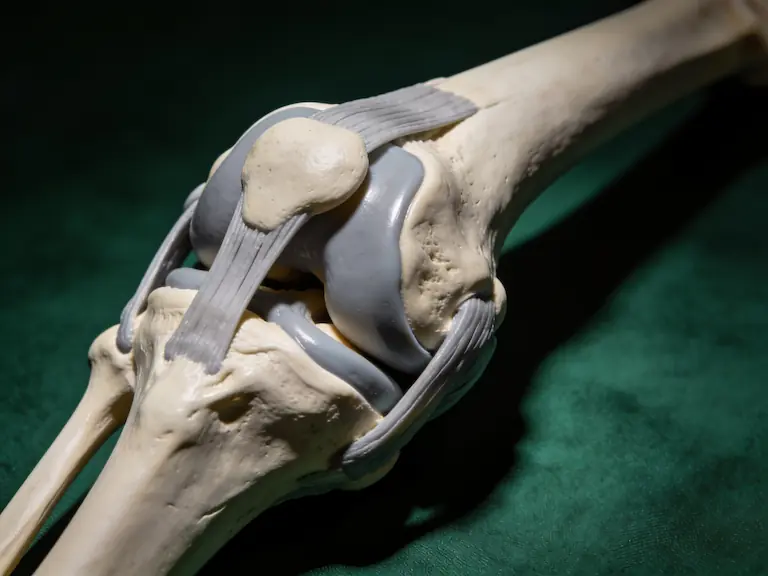
What Is a Torn Meniscus?
Each knee contains two menisci: a medial meniscus on the inner side and a lateral meniscus on the outer side. These are C-shaped wedges of tough fibrocartilage that sit between the thigh bone (femur) and shin bone (tibia). They spread load across the joint surface, absorb impact, improve stability and help the cartilage surfaces glide smoothly. A torn meniscus means part of this cushioning cartilage has split, frayed or become displaced.
Torn meniscus injuries are common. Reported figures suggest roughly 60 to 70 meniscal tears per 100,000 people are diagnosed each year in Western populations. Age-related tears are even more frequent. In one population-based knee MRI study of adults aged 50 to 90, indexed on PubMed, meniscal damage was seen in about 31% of knees. Around 60% of those with a tear reported no knee pain in the previous month. As of 2026, that remains a key reason why scan findings alone do not decide treatment.
Meniscal tears broadly fall into two groups. Traumatic tears usually occur suddenly, often when the knee twists while the foot is planted, during football, rugby, skiing, netball or racquet sports. Degenerative tears develop more gradually as the meniscus becomes less elastic with age, and can appear after a minor movement such as kneeling, squatting or rising from a low chair. Degenerative changes in the meniscus are common from the fourth decade onwards and often coexist with early wear of the joint surfaces.
Symptoms may settle, persist, or come and go over months. Because a torn meniscus can feel very similar to cartilage wear, ligament injury or kneecap problems, an accurate diagnosis matters. The pattern, size and position of a tear influence whether rehabilitation alone is likely to help and whether surgery could be worth considering.
Common Symptoms of a Meniscal Tear
Symptoms can vary considerably depending on the type of tear, its location and whether there is any associated arthritis.
Main symptoms
- Pain along the inner or outer side of the knee, often described as a sharp or pinching sensation
- Swelling that typically builds over several hours to a day or two after an injury
- Clicking, catching or a locking feeling when bending or straightening the knee
- Difficulty fully straightening the knee, which in some cases is described as a locked knee
- A sense of the knee giving way or feeling unreliable on stairs or uneven ground
Secondary symptoms and functional impact
- Stiffness after sitting for long periods or first thing in the morning
- Pain when squatting, kneeling, twisting, pivoting or getting in and out of a car
- Aching at night or discomfort lying on the affected side
- Thigh muscle weakness developing over time as activity reduces
Some patients notice symptoms mainly during activity, with relative comfort at rest, while others describe a persistent background ache. It is also possible to have a meniscal tear visible on imaging with few or no symptoms, which is why findings must always be interpreted alongside your history and examination.
Possible Causes and Risk Factors
Possible causes and contributing factors may include:
- Twisting injuries: rotating the knee under load, especially in contact and multidirectional sports
- Deep flexion activities: heavy squatting, kneeling or lifting from a crouched position
- Age-related change: the meniscus becomes stiffer and more prone to tearing with time
- Associated ligament injury: meniscal tears frequently occur alongside anterior cruciate ligament injuries
- Osteoarthritis: degenerative meniscal tears are commonly associated with wear of the joint surfaces
- Higher body weight: increased load through the knee can add to cartilage stress
- Occupational factors: jobs involving prolonged kneeling, climbing or heavy manual work
- Anatomical variation: conditions such as a discoid lateral meniscus, or significant bow-legged or knock-kneed alignment, may increase risk
- Muscle weakness or previous knee injury: reduced control around the joint can make the knee more vulnerable
When to Seek Medical Advice
You should seek medical advice if knee symptoms are persistent, worsening, or have followed an injury. It is sensible to arrange an assessment if:
- Pain or swelling has not improved after two to three weeks of rest, ice and simple self-care
- The knee repeatedly catches, clicks painfully or gives way
- Symptoms are limiting work, sport, sleep or everyday activities such as stairs
- Physiotherapy or a period of activity modification has not helped
Prompt medical review is advisable if you cannot straighten the knee at all, cannot bear weight, the knee swelled dramatically within an hour of injury, or the joint becomes hot, red and painful with fever, which requires urgent attention. NHS guidance on knee pain and injury offers useful general advice on when to be seen, and your GP can arrange onward referral where appropriate.
How a Torn Meniscus Is Diagnosed
Diagnosis begins with a detailed conversation about how the problem started, the position and nature of the pain, any swelling or locking, your activity level and your goals. A physical examination then assesses:
- Swelling within the joint and the range of movement
- Tenderness along the joint line where the meniscus sits
- Specific rotational tests that may reproduce meniscal pain
- Ligament stability, kneecap tracking and hip function
- Muscle strength, gait and functional tasks such as squatting or step-downs
Imaging is used selectively. Weight-bearing X-rays do not show the meniscus but help assess joint space, alignment and any arthritis. MRI is the most useful scan for showing meniscal tears and associated cartilage or ligament injury, and is generally requested when the findings are likely to change management, in line with the principles set out by NICE. Differential diagnoses considered include osteoarthritis, cruciate or collateral ligament injury, patellofemoral pain, plica irritation, bursitis and, rarely, stress fracture or referred hip pain. Findings are then explained to you in plain language, with the reasoning behind each option.
Treatment Options and Management
Treatment depends on the type of tear, its location, your age, activity level and whether there is associated arthritis. Many patients improve without surgery, and non-surgical care is usually the first step for degenerative tears.
Non-surgical management
- Relative rest from aggravating activities, followed by graded return to loading
- Ice, elevation and simple pain relief used as advised by your clinician or pharmacist
- Structured, physiotherapy-led rehabilitation focusing on quadriceps and hip strength, balance and movement control
- Weight management and activity modification where relevant
- An injection into the joint in selected cases, discussed with its benefits and limitations
Reviews summarised by organisations such as Cochrane indicate that for degenerative meniscal tears, particularly where there is coexisting osteoarthritis, exercise-based rehabilitation gives outcomes comparable to arthroscopic surgery for most people, so surgery is not routinely recommended in that group.
Surgical options
Surgery may be considered when a mechanical problem persists, for example a knee that repeatedly locks, or when symptoms remain limiting despite good quality rehabilitation. Options can include arthroscopic meniscal repair, which aims to preserve the meniscus and is often favoured in younger patients with tears in the outer, better blood-supplied zone, or partial meniscectomy, where a small, irreparable fragment is trimmed. Where advanced arthritis is the dominant problem, discussion may move towards joint preserving procedures or, in selected cases, partial or total knee replacement.
As with any operation, potential risks such as infection, blood clots, stiffness, incomplete symptom relief or the need for further surgery are explained beforehand so that any decision is fully informed. Standards for orthopaedic care in the UK are supported by the British Orthopaedic Association.
Living With and Managing Knee Symptoms
Practical steps that many patients find helpful include:
- Keeping active with lower impact options such as cycling, swimming or walking on level ground
- Continuing strengthening exercises long after pain settles, since muscle support protects the joint
- Avoiding repeated deep squatting, kneeling and twisting during a flare-up
- Warming up properly and building training loads gradually before returning to sport
- Noting which activities trigger symptoms, which helps guide your rehabilitation plan
- Wearing supportive footwear and using a handrail on stairs if the knee feels unreliable
- pain relief with medications
Arrange a review if symptoms plateau, worsen, or if new locking, swelling or instability develops. Information for people living with joint pain is also available from Arthritis UK.
Why Choose Mr Shanmugasundaram Rajkumar?
Mr Shanmugasundaram Rajkumar is a Consultant Trauma and Orthopaedic Surgeon with more than 16 years of consultant experience in hip and knee surgery, joint replacement and complex trauma care. He is fellowship-trained in lower limb arthroplasty and knee surgery, with expertise in knee arthroscopy, cartilage preservation, primary and revision hip and knee replacement, and day-case joint replacement. His previous experience includes Wrightington Hospital, a world class and reputed centre for joint replacement surgery, and he uses ODEP 10A rated hip and knee implants with outcomes evidenced through National Joint Registry and Scottish Arthroplasty Project data.
Alongside clinical practice, Mr Shanmugasundaram Rajkumar is an Honorary Senior Clinical Lecturer at the University of Glasgow, a national lecturer and medical educator in Trauma & Orthopaedics, a College Tutor for the Royal College of Physicians and Surgeons of Glasgow, an active researcher in randomised controlled trials and UK and European multicentre studies, and a reviewer for international orthopaedic journals. Patients can expect a thorough, unhurried assessment, a clear explanation of the findings and honest, evidence-based guidance, including when surgery is not the right answer.
Location and Areas Served
Consultations are available with Mr Shanmugasundaram Rajkumar in Glasgow, with care accessible to patients travelling from surrounding areas of the west of Scotland, including Renfrewshire, where he has been named among the top three orthopaedic surgeons by ThreeBestRated.
Frequently Asked Questions
What causes a torn meniscus?
Tears may follow a twisting injury with the foot planted, deep squatting or kneeling, or they may develop gradually as the meniscus weakens with age. Degenerative tears sometimes occur with very little force.
Can a meniscal tear heal on its own?
Some tears, particularly small ones in the outer part of the meniscus where the blood supply is better, may settle with time and rehabilitation. Many degenerative tears become far less symptomatic with strengthening even when the tear remains visible on a scan.
How is a torn meniscus diagnosed?
Diagnosis is based on your history and a clinical examination, supported by X-rays and, where it will influence treatment, an MRI scan.
Is surgery always needed for a torn meniscus?
No. Surgery is not always necessary and is usually considered when mechanical symptoms such as locking persist, or when good quality rehabilitation has not helped enough. Your clinician will discuss suitable options with you.
Can a meniscal tear come back?
Symptoms can recur, and a repaired meniscus can sometimes re-tear, particularly after a further injury or early return to pivoting sport. Ongoing strengthening and a graded return to activity may reduce that risk.
How long does recovery take?
Recovery varies. Non-surgical rehabilitation often takes several weeks to a few months. Following meniscal repair, protection of the knee is usually needed for longer than after a partial meniscectomy, and your surgeon will give you a personalised timeline.
Next Steps
If you are experiencing symptoms that could suggest a torn meniscus, such as knee pain, swelling, catching or locking, a specialist knee assessment can help identify the underlying cause and guide the most appropriate next steps. To discuss your symptoms and treatment options, you are welcome to arrange an orthopaedic consultation with Mr Shanmugasundaram Rajkumar in Glasgow.
Treatments for this condition
Seeing Mr Rajkumar
New Consultation
£180
Follow-up
£110
Clinics
Ross Hall Hospital, Glasgow
Referral
GP, insurer or self-referral
Get your knee assessed
An unhurried consultation with examination, imaging and a clear explanation.