


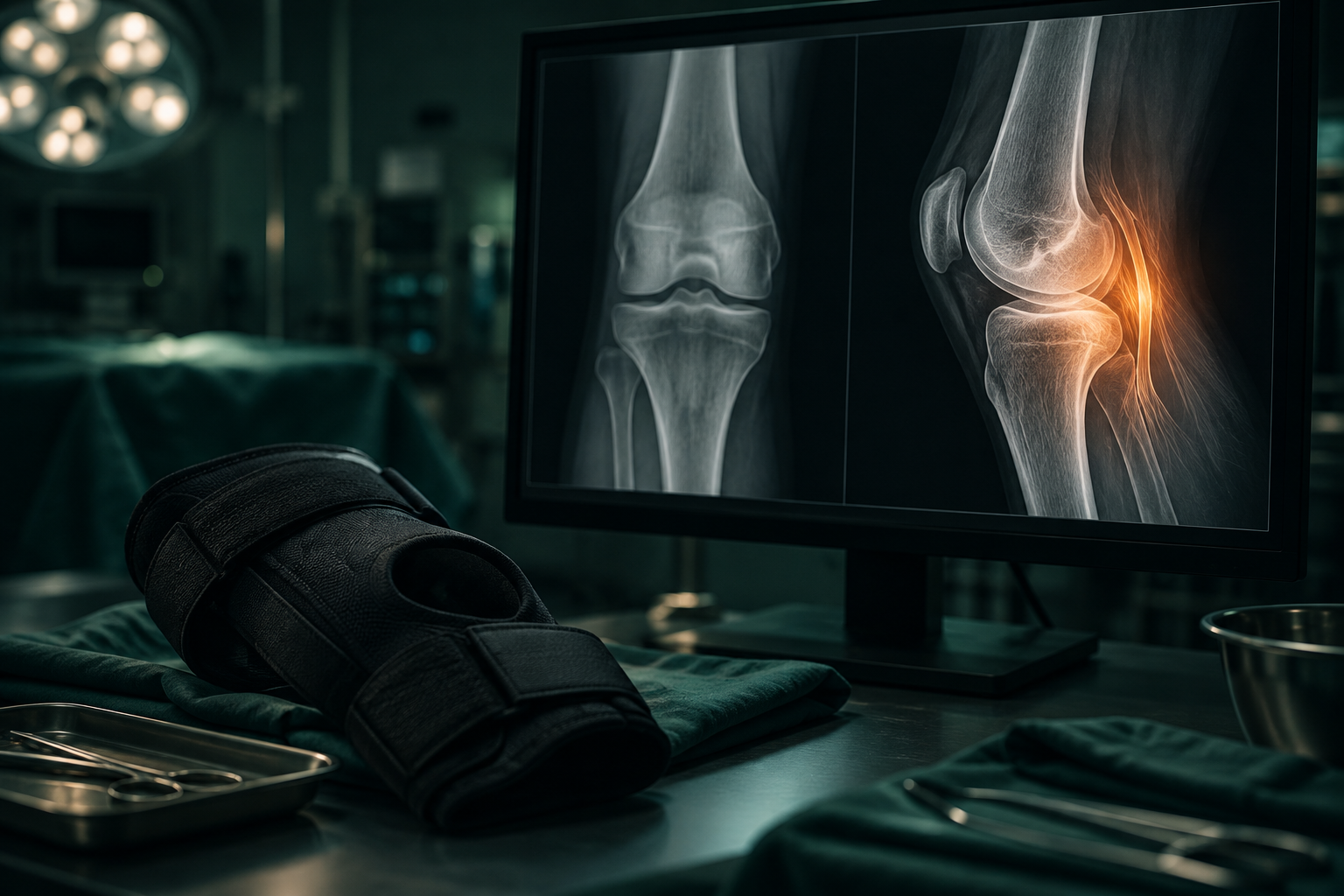
What Is a Soft Tissue Knee Injury?
Patients often seek help because the knee feels unstable, keeps swelling, or gives way. Others come in because the knee locks, or simply does not recover as quickly as expected.
Soft tissue knee injuries are common: the anterior cruciate ligament (ACL) alone is estimated to be injured in around 1 in 3,500 people in the UK each year, most often during sport. Research also suggests that up to 70% of meniscal tears in adults over 40 occur with little or no significant trauma, as part of gradual, age-related degeneration.
A soft tissue injury of the knee refers to damage affecting structures around and within the joint. These are structures that are not bone. These include:
- Ligaments, such as the anterior cruciate ligament (ACL), posterior cruciate ligament (PCL), medial collateral ligament (MCL) and lateral collateral ligament (LCL), which stabilise the joint
- Menisci, the two crescent shaped cartilage cushions that spread load across the joint
- Articular cartilage, the smooth lining on the ends of the bones
- Tendons, such as the patellar and quadriceps tendons
- Muscles and the joint capsule, along with small fluid filled sacs called bursae
Injuries can be sudden (acute), for example a twisting injury during sport or a fall. Or they can develop gradually through repetitive overload, as often happens with tendon problems. Some are self limiting. Others, however, become recurring or contribute to longer term joint wear if the knee remains unstable or poorly supported. Because several structures sit close together and can produce similar symptoms, an accurate diagnosis matters. Treatment for a meniscal tear, for example, may differ considerably from treatment for a ligament sprain or patellar tendinopathy.
Common Symptoms
Symptoms can vary depending on the structure involved and the severity of the injury. Common symptoms may include:
- Pain around the joint line, at the front of the knee, or deep within the joint
- Swelling, which may appear rapidly after an injury or build up gradually over a day or two
- Stiffness and reduced range of movement
- A feeling of instability, or the knee giving way on uneven ground or when turning
- Catching, clicking or locking, which can sometimes be associated with a meniscal or cartilage problem
- Difficulty kneeling, squatting, or going up and down stairs
Some patients recall a pop or tearing sensation at the moment of injury, particularly with ligament tears. Others describe pain that is worse during or after activity and easier with rest. This pattern is common in tendon related problems. Secondary effects can include muscle weakness, especially of the quadriceps, altered walking pattern, and reduced confidence in the knee. Over time these changes may affect work, sport, sleep and general activity levels.
Possible Causes and Risk Factors
Possible causes of a knee soft tissue injury include:
- Twisting or pivoting injuries, common in football, rugby, netball, skiing and racquet sports
- Direct impact to the knee, such as a tackle, road traffic collision or fall
- Hyperextension or awkward landing from a jump
- Repetitive overload from running, jumping, or a sudden increase in training volume
- Degenerative change, where menisci and cartilage become more fragile with age and can tear with minimal trauma
Risk factors can include previous knee injury or surgery, reduced muscle strength or control around the hip and knee, and poor movement technique. They can also include returning to sport before full rehabilitation, and body weight, which increases load through the joint. Anatomical factors such as alignment of the legs and joint laxity may play a role in some people. Occupations involving prolonged kneeling, squatting, climbing or heavy lifting can also increase the risk. Underlying conditions such as inflammatory arthritis or osteoarthritis may make symptoms more persistent. Certain medications have also been associated with tendon problems.
When to Seek Medical Advice
Many minor sprains and strains improve within a few weeks with rest, gradual activity and simple self care. You should seek medical advice if symptoms are persistent, worsening, or follow a significant injury. It is sensible to arrange an assessment if:
- The knee swelled rapidly within a few hours of an injury
- You cannot put weight on the leg or straighten the knee fully
- The knee locks, catches or repeatedly gives way
- Pain and swelling are not settling after two to three weeks of sensible self care
- Symptoms are limiting work, sport or daily activities
Seek urgent medical attention if the knee looks deformed, or if you have severe pain after a high impact injury. The same applies if the joint becomes hot, red and very painful with fever, which can occasionally indicate infection. NHS guidance offers useful advice on initial self care and when to contact a healthcare professional.
How a Soft Tissue Injury of the Knee Is Diagnosed
Diagnosis begins with a careful history. Your clinician will ask how the injury happened, whether there was a pop or immediate swelling, and what makes symptoms better or worse. They will also ask how the knee is affecting your daily life and sport or work. Previous injuries, general health and activity goals are also important.
A physical examination follows, which typically includes assessing swelling, range of movement, joint line tenderness, ligament stability and muscle strength. Specific tests help distinguish between ligament, meniscal and tendon problems. The hip, ankle and gait are often assessed too, because they influence knee loading.
Imaging is used selectively. An X-ray may be requested to exclude a fracture or to assess joint wear. MRI scanning gives detailed images of ligaments, menisci and cartilage. This is used when the diagnosis is unclear or when surgery is being considered. Ultrasound can be helpful for some tendon and bursa problems. In selected cases, knee arthroscopy allows direct assessment of the joint. Your clinician should explain the findings in plain language and discuss how they relate to your symptoms. Scan appearances, after all, do not always match the level of pain experienced.
Treatment Options and Management
Treatment depends on the cause, the structures involved, the severity of symptoms and your individual goals. Options may include:
Non-surgical treatment
- Early self care: relative rest, ice, gentle compression, elevation and early gentle movement as comfort allows
- Pain relief: simple analgesia or anti inflammatory medication may be suitable for some people. Your GP or pharmacist can advise on what is appropriate for you
- Physiotherapy-led rehabilitation: a structured programme to restore range of movement, strength, balance and confidence. This is the mainstay of recovery for most soft tissue knee injuries. The Chartered Society of Physiotherapy provides helpful patient information
- Activity modification and load management: adjusting training volume, surfaces and technique
- Bracing or support, used selectively for certain ligament injuries
- Injections, which may be considered in specific situations after discussion of the potential benefits and risks
Surgical treatment
Surgery is not always needed, and many injuries settle well without it. It may be considered when a knee remains unstable, or when a mechanical problem such as a locked knee does not resolve. It may also be considered when symptoms continue despite a good period of rehabilitation. Options can include arthroscopic meniscal repair or trimming, and ligament reconstruction such as ACL reconstruction. Cartilage preservation procedures may also be considered in selected patients. Guidance from NICE and the British Orthopaedic Association supports an individualised approach. This weighs the likely benefits against the risks of any procedure. Rehabilitation remains essential after surgery.
Living With and Managing a Knee Injury
Recovery is usually a gradual process rather than a single event. Helpful measures include:
- Continuing strengthening work for the quadriceps, hamstrings, calves and hip muscles, even once pain settles
- Increasing activity in stages rather than returning to full sport too quickly
- Keeping a simple record of pain, swelling and activity to identify patterns and triggers
- Warming up properly and including balance and landing drills if you play pivoting sports
- Maintaining a healthy weight and general fitness to reduce load through the joint
- Wearing supportive, appropriate footwear
Arrange a review if symptoms return, if the knee starts giving way again, or if progress stalls despite consistent rehabilitation.
Why Choose Mr Shanmugasundaram Rajkumar?
Mr Shanmugasundaram Rajkumar is an experienced Consultant Trauma and Orthopaedic Surgeon. He specialises in hip and knee surgery, joint replacement and complex trauma care. With more than 16 years of consultant experience, he has particular expertise in knee arthroscopy, cartilage preservation and partial and total knee replacement. His expertise also covers hip replacement and revision joint surgery. He treats soft tissue knee injuries alongside this more complex joint reconstruction work.
- Fellowship-trained in lower limb arthroplasty and knee surgery
- Honorary Senior Clinical Lecturer at the University of Glasgow
- College Tutor for the Royal College of Physicians and Surgeons of Glasgow
- Previous experience at Wrightington Hospital, a recognised centre for joint replacement surgery
- Active researcher involved in randomised controlled trials and UK and European multicentre studies
- Published in peer-reviewed orthopaedic journals and a reviewer for international surgical journals
- National lecturer and medical educator in Trauma & Orthopaedics
His approach is assessment first: understanding the diagnosis clearly and explaining the findings. He also discusses both non-surgical and surgical options so that patients can make an informed choice.
Location and Areas Served
Patients can access orthopaedic consultation with Mr Shanmugasundaram Rajkumar in Glasgow for soft tissue knee injuries and other hip or knee conditions. Support is also available for those travelling from surrounding areas across the west of Scotland.
Frequently Asked Questions
What causes a soft tissue injury of the knee?
Common causes include twisting or pivoting movements, direct impact, awkward landings and repetitive overload from sport or work. Age related changes can also make the menisci and cartilage more vulnerable to tearing with minor trauma.
Can a soft tissue knee injury heal on its own?
Many mild sprains and strains improve within a few weeks with relative rest, gradual movement and strengthening. Some injuries, particularly larger ligament or meniscal tears, may not settle fully without further assessment and treatment.
How long does recovery usually take?
Recovery times vary widely depending on the structure injured and the severity. Minor injuries may improve within a few weeks, while ligament injuries and post-surgical recovery can take several months of structured rehabilitation.
When should I see a specialist?
Consider a specialist knee assessment if the knee swells rapidly after injury, locks or gives way, cannot be fully straightened, or if symptoms persist beyond a few weeks despite sensible self care and physiotherapy.
Is surgery always necessary?
No. Surgery is only one option and is generally considered when symptoms persist despite non-surgical treatment, or when there is significant instability or a mechanical block to movement. Your clinician will discuss suitable options with you.
Can the injury happen again?
Reinjury is possible, particularly if strength and control have not been fully restored or if there is a return to pivoting sport too soon. Ongoing strengthening and a graded return to activity can help reduce the risk.
Next Steps
If you are experiencing symptoms of a soft tissue injury of the knee, such as persistent pain, swelling, locking or instability, a specialist assessment can help identify the cause and guide the most appropriate next steps. To arrange a consultation with Mr Shanmugasundaram Rajkumar in Glasgow, please contact the clinic.
Treatments for this condition
Seeing Mr Rajkumar
New Consultation
£180
Follow-up
£110
Clinics
Ross Hall Hospital, Glasgow
Referral
GP, insurer or self-referral
Get your knee assessed
An unhurried consultation with examination, imaging and a clear explanation.