


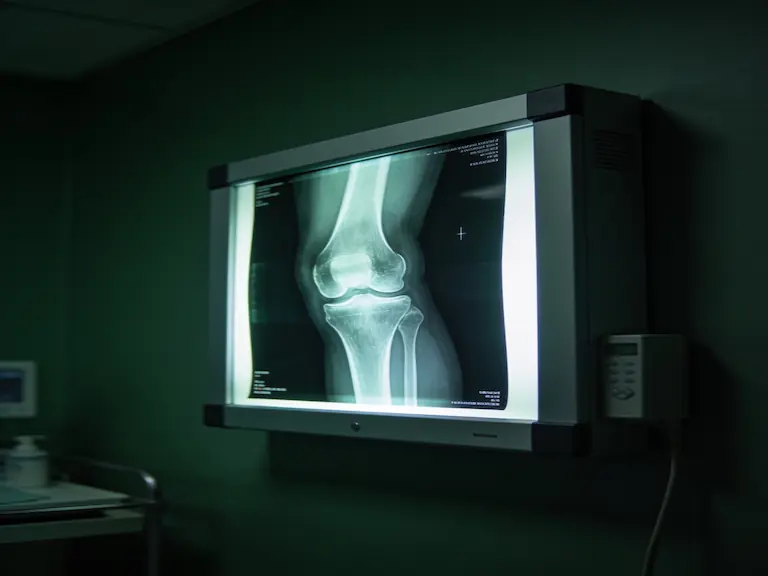
What Is Knee Locking or Clicking?
Noises and mechanical symptoms from the knee are among the most common reasons people seek an orthopaedic opinion. Knee locking or clicking describes a group of symptoms. The knee catches, jams, clunks, grinds or makes audible clicking sounds during movement. For some people these sensations are painless and harmless. For others, they are a sign that something inside the joint is not gliding smoothly. They may be accompanied by pain, swelling or a loss of confidence in the leg.
These symptoms can affect people of all ages, from young sportspeople after a twisting injury to older adults with age-related joint change. Patients often seek help because the knee feels unreliable on stairs. It may give way unexpectedly, or become stuck in one position for a few seconds before releasing.
The knee is a large hinge joint formed by the thigh bone (femur), the shin bone (tibia) and the kneecap (patella). Smooth movement depends on healthy cartilage lining the bone surfaces. It also relies on two crescent-shaped shock absorbers called menisci, strong ligaments, and the surrounding muscles and tendons. When any of these structures is irritated, torn, worn or slightly out of alignment, movement can become less smooth. The joint may then click, clunk or catch.
True locking versus catching and clicking
Clinicians usually distinguish between different types of mechanical symptoms, because they point to different causes:
- True locking: the knee becomes physically stuck and cannot be fully straightened or bent. This often happens because a torn fragment of cartilage or a loose body is trapped between the joint surfaces.
- Pseudo-locking: the knee feels stuck because pain, swelling or muscle spasm temporarily limits movement, rather than because something is physically blocking it.
- Clicking or crepitus: repeated fine clicking, crackling or grinding sounds during bending and straightening, which may come from cartilage surfaces, soft tissue or the kneecap.
- Clunking or snapping: a single louder noise, sometimes from a tendon or band of tissue moving over a bony prominence.
Symptoms may come on suddenly after an injury, or develop gradually over months and years. Some people notice occasional episodes that settle on their own, while others describe a recurring or progressive pattern. Painless clicking is often completely harmless, while true locking can indicate a structural problem. An accurate diagnosis therefore matters. It prevents both unnecessary worry and unnecessary treatment.
How common are knee symptoms?
Knee symptoms are very common in the UK. Around one in four adults over 50 reports knee pain. Arthritis UK estimates that about 10 million people in the UK live with arthritis. As of 2026, knee replacement also remains one of the most frequently performed joint operations, with around 100,000 procedures recorded each year by the National Joint Registry. Most people with clicking knees, however, never need surgery.
Common Symptoms
Symptoms can vary considerably depending on the underlying cause. Common symptoms may include:
- Audible clicking, popping or grinding when bending, squatting or climbing stairs
- A sensation of the knee catching or jamming briefly during movement
- Episodes where the knee becomes stuck and needs to be wiggled or straightened to release
- Pain along the inner or outer side of the joint, or behind the kneecap
- Swelling that appears after activity or the following day
- A feeling of instability, or of the knee giving way
- Stiffness after sitting for long periods or first thing in the morning
Some patients experience symptoms only with specific movements, such as deep squatting, kneeling, twisting or getting out of a car. Others notice that discomfort improves with rest and returns with sport or prolonged walking. The functional impact ranges from mild irritation to a genuine loss of confidence in the leg. This can affect work, driving, exercise and sleep. Note which movements trigger your symptoms. This detail greatly helps at your appointment.
Possible Causes and Risk Factors
Possible causes of knee clicking and locking include both harmless mechanical noises and identifiable joint problems.
Common causes
- Meniscal tears: a torn meniscus can leave a flap of cartilage that catches between the joint surfaces. This is one of the classic causes of true locking. Tears may follow a twisting injury in younger people or occur with minimal trauma in degenerate cartilage later in life.
- Cartilage damage or a loose body: a fragment of cartilage or bone floating within the joint can intermittently jam movement.
- Patellofemoral problems: irritation of the cartilage behind the kneecap, or a kneecap that does not track smoothly, is a common cause. It often produces clicking, grinding and pain on stairs or after sitting.
- Osteoarthritis: gradual loss of the smooth cartilage surface commonly causes crepitus, stiffness and aching. Helpful patient information is available from Arthritis UK and NICE.
- Ligament injury: instability after an anterior cruciate ligament injury can lead to secondary cartilage damage and mechanical symptoms.
- Tendon or soft tissue causes: a snapping sensation may arise from a tendon or fibrous band moving over bone, or from a fold of joint lining (a plica) becoming irritated.
Treatments for this condition
Seeing Mr Rajkumar
New Consultation
£180
Follow-up
£110
Clinics
Ross Hall Hospital, Glasgow
Referral
GP, insurer or self-referral
Get your knee assessed
An unhurried consultation with examination, imaging and a clear explanation.