


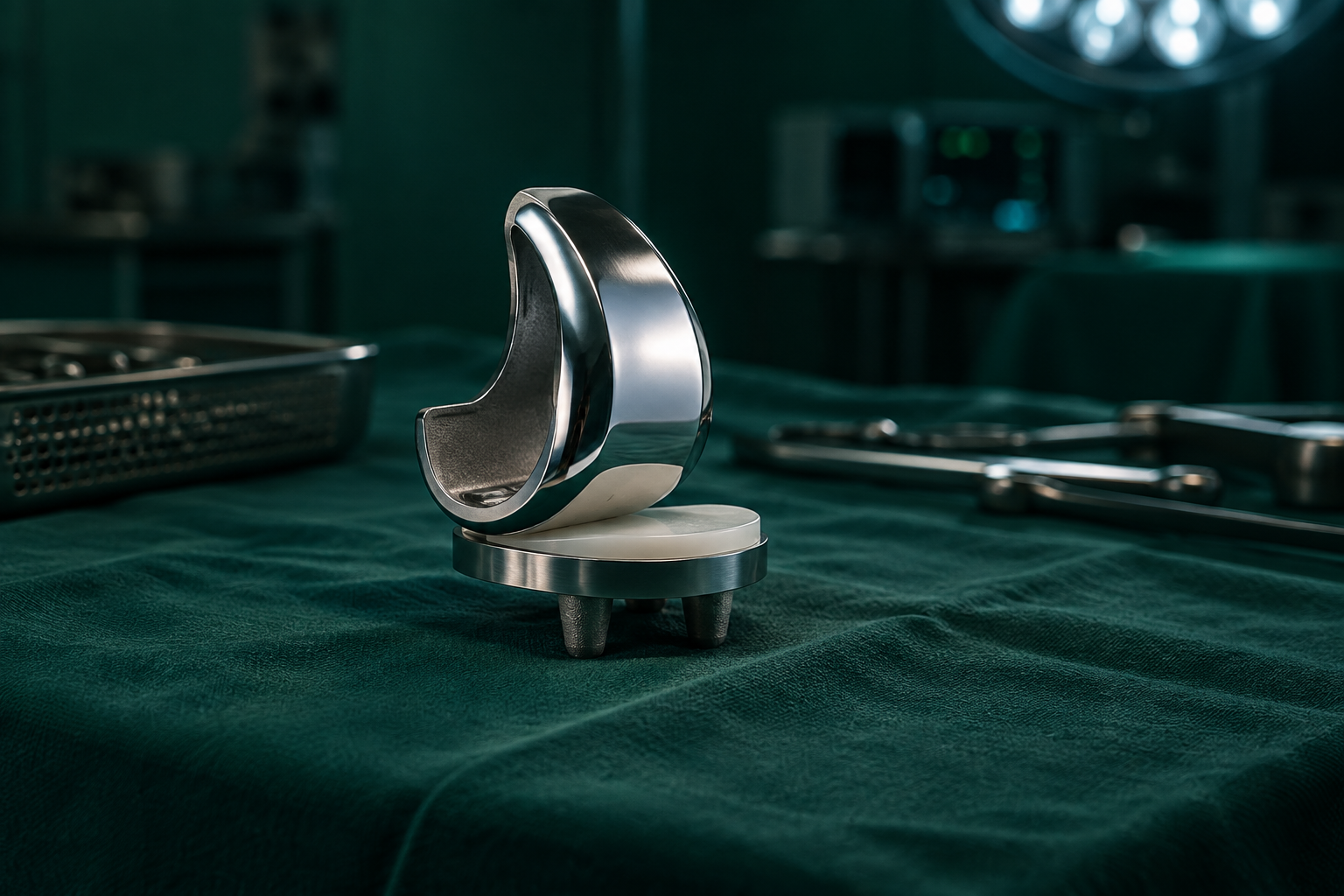
What Is a Partial Knee Replacement?
The knee is made up of three compartments: the inner (medial) side and the outer (lateral) side. The third is the joint between the kneecap and the thigh bone (patellofemoral). Osteoarthritis does not always affect all three. When wear is limited to a single compartment, it may be possible to resurface only that area. This avoids replacing the whole joint.
During the procedure, the worn surfaces of the affected compartment are removed and replaced with metal components. A plastic (polyethylene) bearing sits between them to allow smooth movement. The cruciate ligaments and the healthy cartilage in the rest of the knee are preserved. This is one reason many patients report that the knee feels closer to normal after this type of surgery.
Partial knee replacement is a surgical treatment, usually offered after simpler measures have been tried. It sits within a wider range of options for knee arthritis. These options include activity modification, weight management, physiotherapy, pain relief, injections, knee arthroscopy in selected cases, and total knee replacement. Guidance on the management of osteoarthritis is published by NICE. Joint replacement is generally reserved for people whose symptoms substantially affect their quality of life despite conservative care.
Who May Benefit From This Procedure?
Suitability depends on your symptoms, examination findings and imaging, and it is assessed individually. A partial knee replacement may be considered if you experience:
- Pain localised to one side of the knee, often the inner side, rather than pain spread across the whole joint
- Pain that disturbs sleep or that persists at rest
- Difficulty walking, using stairs, driving or standing for long periods
- Stiffness, swelling or a sense of the knee giving way
- Limited benefit from painkillers, physiotherapy, injections or activity changes
- X-ray changes showing wear confined to a single compartment
This operation is generally less suitable where arthritis affects more than one compartment, or where there is significant inflammatory arthritis such as rheumatoid disease. It is also less suitable where there is a large fixed deformity, or where the ligaments are deficient. In those situations, a total knee replacement may be recommended instead. Your surgeon will explain which approach is likely to suit your knee and why.
Conditions and Problems It May Address
- Medial or lateral compartment osteoarthritis
- Post-traumatic arthritis following an old fracture or ligament injury
- Localised cartilage loss with bone-on-bone change on X-ray
- Avascular necrosis (osteonecrosis) affecting one femoral condyle
- Persistent mechanical symptoms and functional limitation after failed conservative treatment
Reliable patient information on arthritis and its management is available from Arthritis UK and the NHS.
Potential Benefits
Outcomes vary between individuals, and no operation can guarantee a particular result. That said, for appropriately selected patients, partial knee replacement surgery may:
- Reduce arthritic knee pain and improve sleep
- Improve walking distance, stair use and everyday function
- Preserve more of the natural knee, including the cruciate ligaments
- Involve a smaller incision, less bone removal and often a quicker early recovery than total knee replacement
- Allow a more natural feeling knee and better range of movement in many cases
- Be suitable for day-case or short-stay surgery in selected patients
- Leave the option of conversion to a total knee replacement later if arthritis progresses
Registry data collected by the National Joint Registry shows that unicompartmental implants have a somewhat higher revision rate than total knee replacements. The balance of benefit and risk is discussed carefully before any decision is made.
Your Recovery Timeline
- Day 0: Many patients walk with support the same day, some go home the same day
- Week 1–2: Walking with sticks or crutches, wound checks and physiotherapy begin
- Week 4–6: Walking unaided is common, with a return to light activities
- Month 3: Most patients are back to normal daily activities and low-impact sport
Consultation and Assessment
Careful assessment is the most important part of the process, because patient selection strongly influences the outcome of unicompartmental surgery. A consultation with Mr Shanmugasundaram Rajkumar usually includes:
- A discussion of your symptoms, how long they have been present, and how they affect work, sleep, hobbies and daily life
- A review of your general health, medications, previous injuries and past surgery
- A clinical examination of the knee, hip and gait, checking alignment, ligament stability, movement and areas of tenderness
- Weight-bearing X-rays, and occasionally an MRI scan, to confirm which compartments are affected
- An explanation of all reasonable options, including continuing non-surgical treatment
- A frank discussion of the likely benefits, the risks, the recovery timeline and the expected implant longevity
You will have time to ask questions and to consider your options before consenting to surgery. Pre-operative checks, anaesthetic assessment and prehabilitation exercises are arranged where appropriate.
How the Operation Is Performed
Surgery takes place in a hospital operating theatre. It is usually carried out under spinal anaesthetic with sedation, or under general anaesthetic. This is sometimes combined with a local anaesthetic nerve block for pain relief. The anaesthetist will discuss the safest choice for you.
Through a smaller incision than that used for a total knee replacement, the worn surfaces of the affected compartment are exposed. They are then prepared and precisely resurfaced. Trial components are used to check alignment, stability and movement before the definitive implants are fitted, usually with bone cement. The wound is closed and dressed, and the knee is checked again before you leave theatre. The operation commonly takes around an hour, although this varies.
Many patients are able to stand and walk with support on the same day. Selected, well-prepared patients may be suitable for day-case surgery. Others stay one or two nights. Mr Shanmugasundaram Rajkumar uses implants with strong evidence ratings, including ODEP rated knee components. Outcomes are recorded through National Joint Registry and Scottish Arthroplasty Project data.
Recovery and Aftercare
Recovery differs from person to person, and your team will give you a plan tailored to your knee and your general health. In broad terms you can expect:
The First Few Weeks
- Walking with crutches or a stick at first, progressing as comfort allows
- Regular pain relief, ice and elevation to help with swelling
- Early physiotherapy exercises to restore movement and quadriceps strength
- Measures to reduce the risk of blood clots, which may include medication and early mobilisation
- A wound check and follow-up appointment, typically within the first two weeks
The Following Months
- Many people return to driving once they can perform an emergency stop safely and comfortably, often at around four to six weeks
- Return to office work is often possible within a few weeks, with longer needed for physically demanding jobs
- Swelling and occasional discomfort can continue to settle over several months
- Low impact activities such as walking, cycling, swimming and golf are usually encouraged once strength returns
Seek urgent medical advice if you develop increasing pain, redness or discharge from the wound, or fever. Also seek help for calf pain or swelling, or sudden breathlessness or chest pain.
Risks and Considerations
All surgery carries risk. Complications are uncommon but must be understood before you consent. Possible risks include infection, bleeding or bruising, blood clots in the leg or lungs, stiffness and persistent pain. Further risks include nerve or blood vessel injury, fracture, loosening or wear of the implant. Longer-term risks include progression of arthritis in the other compartments, and the need for further surgery including conversion to a total knee replacement. Anaesthetic risks will be explained separately.
It is also important to recognise the limitations. A replaced knee is not a normal knee, and high impact sports such as running are usually discouraged. Implants also have a finite lifespan. Some patients are better served by continued non-surgical care or by a total knee replacement. Professional standards for orthopaedic care in the UK are set out by the British Orthopaedic Association.
Why Consider Mr Shanmugasundaram Rajkumar?
Mr Shanmugasundaram Rajkumar is a Consultant Trauma and Orthopaedic Surgeon with more than 16 years of consultant experience. He specialises in hip and knee surgery, joint replacement and complex trauma care. He is fellowship-trained in lower limb arthroplasty and knee surgery. He also has previous experience at Wrightington Hospital, a long-established centre for joint replacement surgery.
- Honorary Senior Clinical Lecturer at the University of Glasgow
- College Tutor/Regional Surgical Advisor for the Royal College of Physicians and Surgeons of Glasgow
- Expertise in primary and revision hip and knee replacement, knee arthroscopy and cartilage preservation surgery
- Use of ODEP 10A rated hip and knee implants, with outcomes evidenced through National Joint Registry and Scottish Arthroplasty Project data.
- Experience in day-case joint replacement pathways for suitable patients
- Active researcher involved in randomised controlled trials and UK and European multicentre studies
- Published in peer-reviewed orthopaedic journals and a reviewer and consulting editor for international journals
- National lecturer and medical educator in Trauma & Orthopaedics
Location and Areas Served
Consultations and knee surgery are provided in Glasgow. Patients also travel from across the west of Scotland, including Renfrewshire and surrounding communities. Appointment times, hospital locations and clinic details can be confirmed when you get in touch.
Frequently Asked Questions
Is the operation painful?
You will not feel the procedure itself because of the anaesthetic. Discomfort afterwards is expected and is managed with regular pain relief, nerve blocks where appropriate, ice and early movement. Most people find pain improves steadily over the first few weeks.
How long does surgery take?
The operation itself commonly takes around an hour. You will be in hospital for longer to allow for anaesthetic, recovery and physiotherapy.
How long is recovery?
Many patients walk on the day of surgery and manage independently within a few weeks. Strength, confidence and swelling usually continue to improve over three to six months, and sometimes longer.
Am I suitable for a partial knee replacement?
Only an individual assessment can answer this. Suitability depends on which compartments are affected, ligament stability, alignment, your symptoms and your general health.
What are the alternatives?
Alternatives may include physiotherapy, weight management, pain relief, injections, bracing, osteotomy in selected younger patients, or total knee replacement. Your surgeon will discuss which options are reasonable for your knee.
How long does the implant last?
Most partial knee replacements function well for many years. Implants can wear or loosen over time, and arthritis may progress elsewhere in the knee. Registry data helps inform realistic expectations.
When should I book a consultation?
It is reasonable to seek a specialist opinion if knee pain limits your walking, sleep or work. This applies especially after several months of conservative treatment.
At a glance
Anaesthetic
Spinal or general
Operation time
Around 45–60 minutes
Hospital stay
Often day-case or 1-2 nights
Recovery
Commonly 4–6 weeks
Implants
100% ODEP 10A-rated
Fees & insurance
New Consultation
£180
Follow-up
£110
Insurers
Bupa · AXA Health · Aviva · Vitality · WPA
Self-pay
All-inclusive quotation on request
A written quotation is provided before any procedure is booked.
Discuss your knee
Request an appointment at Ross Hall Hospital, Glasgow.